Search This Blog

Tuesday, March 27, 2012

Book Review: Ravi Zacharias' "Why Jesus?"

A few weeks ago one of our daughters, age 11, attended the birthday party of a classmate. The classmate participates in a yoga class and thought it would be unique and different to hold her party there. Our daughter was not impressed afterwards. As soon as she walked in the door home she flashed a bemused smile, cocked her head sideways and pronounced, “Weird! That was the weirdest thing I’ve ever done!”

It may or may not surprise you to hear that my daughter and her classmates all attend a Christian school. And so the party plans raised a few parents’ eyebrows. But then most American Christians’ eyebrows will lift in puzzlement if you suggest yoga is inextricably intertwined with the metaphysics of Hinduism. That’s not how they experience it. They experience it as just an exercise class, so what’s the problem?
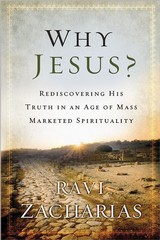
Ravi Zacharias would call this a consequence of “Weasternism.” It’s a term he coined in his latest book, Why Jesus? Rediscovering His Truth in an Age of Mass Marketed Spirituality. Ravi calls mass marketed spirituality “New Spirituality,” and its Weasternism seductively merges Eastern spirituality with Western materialism. The seduction of the New Spirituality is that the individual is lured into becoming his/her own spiritual arbiter and authority. The two most prominent proponents of this are Oprah and Chopra, whose names together sound like the proprietors of an exotic boutique. But Oprah Winfrey and Deepak Chopra influence millions of people with muddled spiritual thought. Ravi takes them on, especially Chopra, in this book.
Ravi is as formidable a philosopher and Christian apologist as exists. He has lectured and ministered all over the world for four decades. As a man who grew up in India but lived his adult life in America, Ravi has a unique cultural vantage point. He’s an incisive surveyor of spiritual topographies, a seismologist of both the Eastern and Western soul.
The easy enculturation of Eastern spirituality to Western sensibilities is explained by the increasing willingness of many Americans to absorb beliefs rather indiscriminately. We’re a self-made people who apply our entrepreneurism of life to matters of the spirit, baptizing “whatever works.” Truth is in the eye of the beholder, and Ravi very capably describes how we got here and what’s at stake. This is Ravi at his best, as field guide to the habitats of truth and error. Having read other Ravi books through the years I was re-impressed with Ravi’s deftness in advancing the uniqueness of Jesus as the person of truth for everyone. Because confidence in the Bible is integral to this conviction Ravi concludes the book with a suggested bibliography on the authority of the Scriptures.
Chopra and others redefine Jesus or don’t allow him to speak for himself apart from their prism. In their view Jesus is someone who obtained the kind of God-consciousness we all have within us awaiting discovery. Ravi shows his readers why no one searching for divinity in themselves finds it, and why it is impossible to grant to each person their own subjective spiritual authority. For a church that too easily lets itself lose its way in the fog of trendy spirituality, Ravi’s book is like the lights of an airport landing strip.
My friend Melissa Ruleman at the Commercial Appeal also penned a review of Ravi’s book here: http://www.commercialappeal.com/news/2012/mar/03/faith-and-culture-apologist-takes-on-wests-mass/

Saturday, March 24, 2012

Confessions of a Flu Fighter

I’m writing these words at the end of a week dominated by flu. A few of our kids developed symptoms first then shared with me. I preached last Sunday morning (March 18) feeling miserable but functional enough. It wasn’t equivalent to Michael Jordan’s heroics in Game 5 of the 1997 NBA Finals (“The Flu Game”). But when you’re usually healthy, sickness is disorienting as well as disabling. It wasn’t just that I didn’t feel like myself but that I felt strangely un-self.

I think I believe that every experience in life is instructive. And so I pause now to consider what I’ve learned this week hosting that most unwelcome houseguest within my members, Influenza. Perhaps it’s not so much that I’ve “learned” anything new or even been reminded of this or that, as if I’d come to believe I couldn’t succumb to sickness. The flu caught me but not by surprise. So then it is probably better to say spending this past week sick at home has reinforced and re-sensitized me to some things I already knew about myself.

Not that I have a lot of experience with sickness. Lynn has even less. We’re grateful for our health and work to take care of it. I have a missionary friend from seminary days who once told me, mostly tongue-in-cheek, that God seems to give His servants either money problems or health problems, and if He really loves you He gives you both! I take the flu as a matter of course in a fallen world. I don’t know that a threat to my health might not be coming later that will make me wistful for “just the flu” of this past week.

The flu is challenging and all I’ve done for a week is lie around groaning in and out of fever. But I knew it would run its course and lift. I saw my doctor and got on Tamiflu about three days in and symptoms began alleviating although weakness has lingered. But I also pondered: What if I had to live in my symptoms for a month, a year, a lifetime? It’s one thing knowing you’ll be down and out for a week—you get to watch movies and eat popsicles and get ahead in your reading and take naps and never put on pants. But what if illness became part of regular life for me?

I watch others navigate lives chronically beset by illnesses both known and mysterious. Many of these folks are marvels of endurance and grace and energy. It’s easier for me to sympathize for them than empathize with them though because empathy requires shared suffering, or as Joe Aldrich memorably described it, “becoming a naturalized citizen of another’s world.” And so one advantage of spending a week with the flu is I grow at least a little in empathy for my friends who suffer ailments or the restrictions thereof more constantly than me.

I’m a runner. I can go run multiple miles whenever I want to in any kind of weather. But I couldn’t even walk a mile in our neighborhood this last week on a beautiful spring afternoon without feeling spent. I know because I tried it, wrongly concluding it would make me feel better. That’s one way I knew I was really sick. But this is one week of limited lung capacity for me. This time next week I’ll be running my route, likely not even thinking of this week that’s been. That’s almost like having health to burn.

Because I don’t have obvious physical restrictions I have a tendency to run past or overlook the weak and the frail instead of waiting for them or pursuing them. Because of my health I have a tendency to look down on the unhealthy. I hate to confess this but it’s true. The experience of being weakened this week has re-sensitized me to my easygoing dismissiveness in these ways and triggered repentance.
So it was good for me to be afflicted this week, yes (Ps. 119:71). It made me more sentient of my mortality and depravity both, and that invariably drives me to Jesus. In fact, as I think about it now my bout of influenza has prepared me for Easter in a way no meditation I voluntarily engaged probably could, in that Easter is about the dead coming back to life. In the midst of the flu one says he feels so bad he wishes he could die. I said so a couple of times last week. But I didn’t really want to die. (And now that I’m on the mend I’m glad I didn’t!)

“I wish I could die” is really wanting relief from the pain and frustration of the illness. The more difficult the illness the more one not only desires his wellness but enjoys it when it returns. Same with the sickness in our souls called sin. It is death to us, death in us. But we don’t really want to die from it. Easter is the only way to ultimate wellness. Tamiflu was good for my body but Easter is good for my person. It is life no sickness can infect or consume, health no death can rob from me, healing that never ends, never fails.

Thinking of this, I feel so good now I hope there is one more popsicle left in the freezer for me.

Monday, March 12, 2012

The Birds and the Bees and the Chickens and the Ostriches

It’s Spring Break in Memphis. Today my wife Lynn took our daughter Holly (11) away on a mother-daughter retreat. They’ll stay a couple of days at a friend’s lakehouse. Holly is our middle child of five so her older sister and brother have gone on this same retreat with Mom and Dad, respectively. It comes with turning 11 in the Huffman household.

The retreat reinforces a discussion we begin with each of our children when they turn 9 years of age (we have two boys and three girls—two retreats for me and three for Lynn). It’s the sex discussion. Lynn and I together have “the talk” with each child at age 9. Then at age 11, the one taking the child on the retreat goes through Family Life’s “Passport to Purity” curriculum with him/her.
That material is broken into a handful of sessions. Each session includes listening to a recorded talk by Dennis or Barbara Rainey addressing everything from pubic hair to the reason why boys shouldn’t pop girls’ bra straps at school. The child, sometimes giggling but also listening intently, takes his/her notes in a provided notebook. Afterwards the parent and child discuss what they heard, the parent adds his/her insights and experiences, and at the end of the retreat we give the child a ceremonial gift to remember the time by. We also try to do something fun too. My oldest son Caleb and I had our retreat in Branson, Missouri, and took in some of the sights there.
It’s on this retreat that we begin talking more specifically about what dating will look like and how he/she needs to prepare for navigating a highly eroticized Western society. The eroticization of our society is one reason why we have “the talk” with our children at 9 years old. By that age, third grade, they’ve already heard things about sex from media and from peers at school (oh yes, at Christian school too!).
What helped Lynn and me overcome our nervous reticence to talk to our kids about sex was realizing we were engaging them in a healthy conversation about themselves. There is no one better suited to do this than the parent. We are each one of us sexual beings and to try to deny or hide this from our kids does them no service. That some will never express themselves sexually (see Matt. 19:12; 1 Cor. 7:25-28) is something to be respected, not ridiculed or otherwise viewed as odd. That’s a cultural view of sex—that those who never have sex are somehow not fully alive—opposed to a Christian view.
Kids mature at differing rates and intensities, of course, but we don’t think the age of 9 is too early in today’s cultural climate for a kid to learn facts about sex. We also don’t think we should hold anything back from them when we begin the discussion. That is we tell our children why they have gender and we tell them of God’s design and purposes for sexuality and sexual expression—the stuff of Genesis 1 and 2. But we also tell them candidly how people abuse and spoil God’s good design through sex outside of marriage, pornography, and homosexuality—the consequences of the fall, Genesis 3. We’d rather they hear about sexual aberration from us first because we’ll rightly inform them and contextualize it, whereas media and peers will not. We’re also emboldened to tell them of those realities because the Bible doesn’t hide sexual malpractice from its readers.
Part of the talk at age 9 includes an affirmation of their responsibility to confidentiality. We call them to maturely steward the knowledge we give them, telling them that they know what they know now to neither impress nor inform their friends. Caleb learned the social cost of this the hard way soon after his retreat at age 11 with me. A couple of neighbor boys were having a misinformed conversation about homosexual acts as they shot basketball in a driveway. They weren’t being curious but pejorative. Knowing he knew better what they were talking about, Caleb corrected their nonfactual ideas. They in turn promptly told their parents “what Caleb said,” and the parents informed me that Caleb was banned from socializing with their boys for a time.
I remember the phone conversation with the father of one of the boys. He said to me, with evident surprise in his voice, “Turns out what Caleb said is true, but I still don’t want [his son’s name] knowing about it.” I resisted the urge to respond tartly with, “Your boy initiated the discussion, pal—he’s already talking about it!” and instead tried to make it a teaching moment. But he was even more surprised to learn Caleb knew what he knew because Lynn and I told him about it. I think he would have right then nominated me for Reckless Parent of the Year.
Nonetheless, I think for our oldest three kids it has been better for them to know the facts of life earlier as opposed to later. Yes, you feel as a parent you’re imposing on their innocence some when you begin the discussion. But there is a difference between preserving innocence and perpetuating sentimentality. Our kids do grow up and we need to help them navigate a clouded culture concerning sex and sexuality. They need to know how to fly by the instrument panel when they can’t see the horizon.
Knowing what they know when they know it has made my kids less boy/girl-crazy. We find the kids fitting that description to often be those who’ve had their ideas and attitudes toward sex shaped predominately by media and peers, not their parents. Our kids confirm this is so as we ask about their peers. We think parents in the church are not so much chickens as ostriches about this: too many have their heads in the sand hoping puberty might go away or never arrive.
Knowing what they know when they know it has also removed some of the mystique of the opposite sex and the naivety that allows for “curiosity that kills the cat.” Our kids are still kids, red-blooded and interested in the opposite sex. We’ve told them this is good and for this we’re glad. We’ll allow them to date within intentional parameters and we pray for their future spouses now as much as we pray for them (assuming they’ll marry). And we know our kids can still make mistakes in days to come with boyfriends and girlfriends. Imparting wisdom does not insure against every weakness of the flesh.
But we’d rather impart and invest. So somewhere on a lakeside dock in north Alabama, the birds chirping and the bees buzzing here at the cusp of spring, Lynn is telling Holly about some things she knows and some things she doesn’t. And I’m trying to figure out what to serve her brothers and sisters for dinner tonight in Mama’s absence. Don’t worry, it won’t be Hooters.
Saturday, March 3, 2012

What is the Role of Pastors in Presidential Campaigns?

My reply at Faith in Memphis: http://faithinmemphis.com/2012/03/02/pastors-should-model-what-to-assess-in-choosing-a-candiate/ The link I provided them to a post I wrote on this blog in December ("How Then Should We Vote?") wasn't included in the Faith in Memphis post but can be accessed here: http://colehuffman.blogspot.com/2011/12/how-then-should-we-vote.html

Saturday, February 25, 2012

The Dream of the Seventy-Seven

I had a dream the other night in which I was addressing seventy-seven young men, all in their thirties, who were about to take the pastoral helms of seventy-seven churches and each church was, like First Evan, at least seventy-seven years in existence. Such dreams always seem to follow when I read Revelation over a late-night plate of enchiladas. Here are some of the things I heard myself telling those pastors:

·         Toughen up without losing your tenderness. You will be told no sometimes by the elders of your church and that is good for you. You will not be equally loved or affirmed by all in your congregation and that is good for you. You will have to wait sometimes for what you want and that too is good for you. Faithfulness and patience, both fruits of the Spirit, do not ripen without troubles, delays, and denials. Lose the glass jaw that sends you to the mat in a heap of self-pity when you’re opposed or something you champion is defeated or needlessly delayed from your vantage point. Thank God in those times that He is still perfecting your character. If you got everything you wanted you’d be pastoring Heaven. These are real live people you’re dealing with, you know.

·         Make friends with your predecessors, both living and dead. In an “old growth” church with history, memories are deeply rooted and the pastoral eras are the rings in the tree. The pastors who went before you were compared to the pastors who went before them too. Make peace with the players of the past and pray for the ones who will follow you as you pray for yourself. Someday you too will become their “former” pastor. Endeavor to pass to your successor—who will grow tired of being compared to you—a healthy church.

·         Work to cultivate new blooms on old branches. Most of what you’ll find in your church—even if the church is withering away or a total rebuild project—doesn’t require uprooting as much as pruning. Jesus did curse the fig-less fig tree that, like the people, wasn’t prepared for His coming. But to those who have received Him, He prunes, seeking new and lasting fruit. Help your church understand its values and how to maximize them.

·         You can tolerate inefficiency but not inertia. Inefficiency or inexactitude in the structure, function, and culture of your church is aggravating to differing degrees but it doesn’t really threaten vision. Inertia does though because inertia is not simply inactivity but inattentiveness. Pastors are not babysitters. Where there is inertia in the church it means your people aren’t paying attention to God and wasting their lives, the biblical definition of folly. That’s a vision problem and needs to be addressed with a truer, more expansive view of God. You can leave your church for persistent inertia—if you’re always told no or resisted at every turn—but not for inefficiencies in its structure, function, and culture. Those you work with and work through.
(A "by the way" on leaving churches: the grass may indeed be comparatively greener in another pasture but there are sheep patties in that grass too. Go into a different line of work if you’re trying to avoid institutional or people problems—weather station manager in Antarctica might be a good choice for you.)

·         The catalytic leaders that headline Christian conferences really don’t have much to say to you. Don’t get me wrong: Take wisdom wherever you can find it and remain evangelically teachable to those who are organizationally excellent and insightful. But the young leaders evangelicals tend to bronze have often done their best to avoid, flee, or blow up the kind of church you’re in, believing it is a bastion of mediocrity. They’re not bad guys, so don’t regard them cynically. And some of them may become your friends (take friendship wherever you can find it too), so don’t behold them enviously. They’ve just never had to work for change in an entity like your church. You’re working out different muscle groups of leadership than they are, that’s all.

·         Astringency is not coercion. The difference is that astringent leadership will call people to do what they resist for a greater good they’ll later see. Coercion makes people do what they resist for the leader’s own purposes—to prove oneself in some way. Coercion will result in short-term compliance but long-term resistance. Sometimes you have to lead astringently; sometimes you need to position yourself or your proposal such that you risk being told no. But with coercion’s tools you’re building the casket into which your people’s respect for you will lie.

·         If you love your people they will love you back. Mostly true. But this old saying is never truer than in traditional-set churches: You can’t win them all. Don’t hide from anyone. Practice relational integrity with all. But don’t kill yourself pursuing people who are disinterested in what you’re calling for or indifferent to you. And be who you are, not your best impression of anyone else. If it comes to it you’d rather be fired as (state your name here). Know who you are, learn to like who you are, and be who you are. Apply the same to your congregation and unless they are Orcs you should have mostly agreeable experiences with them.
 
Well, I said other things in my dream state to those seventy-seven young pastors headed to older churches; things about discerning values and directional matters and how to cope when your church insists on serving Taco Salad on Wednesday nights. I’ll keep those things between them and me. But the reality breaking in on my sleep that night is that I love the church that has some age on it and want churches like First Evan to be led well. It sure makes me sleep better at night.

Thursday, February 16, 2012

Pointing at Train Wrecks

In a vividly worded piece of cultural insight Kathleen Parker, syndicated columnist for The Washington Post, refers to paparazzi as “parasites that coagulate on the souls of the talented.” Souls like Whitney Houston—exceptionally talented singer yet addicted woman. Parker wrote her column yesterday against the backdrop of Houston’s death at 48 (link: http://www.washingtonpost.com/opinions/whitney-houston-and-the-curse-of-fame/2012/02/14/gIQAnrJUER_story.html).
The teachable moment emerging from Houston’s hotel room, Parker says, is not about the dangers of mixing alcohol and drugs but the toxic mix of misery and celebrity. Why does it seem so many of those who “make it big” get caught in the gravitational pull of small orbits like addiction? She probes the role of intrusive public acclaim in the unraveling of lives like Houston’s. We, the ravenous public, believe that superlative gifts are bequeathed to the select few for us, the masses. So we pay for their music, books, art, athleticism, making them rich and famous. But if they show a prominent flaw or weakness—boy, do we make them pay us back. This has to take a toll on their psyche.
Jack Johnson’s song “Good People” is about the personality carnival television has become. One of the lines is, “How many train wrecks do we need to see?” Yes, Whitney Houston was her own conductor on the crazy train of a highly publicized drug addiction. The train wrecked last week and she, not her public, was at the controls of her own demise.
But Whitney Houston wasn’t the only one addicted. We are also. We’re addicted to seeing the train wrecks. It gives us something to talk and tweet about, criticize, belittle, mock, pray the Pharisee prayer in response (see Luke 18:9-14). Parker presents the media’s role in this as that of drug dealer. Being their junkies, we have allowed ourselves to regard celebrities as less than truly human.
Take Britney Spears. I don’t know her although two of six degrees of separation could make our acquaintance: I did doctoral work with her former youth pastor and her original voice teacher is a member of my church. Among evangelicals, before Katy Perry, Spears was the poster child for church girls gone wild. Christians began to view her through the lens of her celebrity and treated her as an enemy of decency and decorum. She was, after all, corrupting our girls and seducing our boys.
A few years ago Spears had a train-wreck kind of meltdown. I found it painful to watch a beautiful young woman with shaved head beating a paparazzi car with an umbrella. It evoked compassion for her and repentance in me, for I too had bashed her at times.
A little while later I bought Bebo Norman’s self-titled album (2008) on which he included this song he wrote after viewing news footage of Spears’ troubles. He called it “Britney”:
“Britney I'm sorry for the lies we told
We took you into our arms and then left you cold
Britney I'm sorry for this cruel, cruel world
We sell the beauty but destroy the girl
“Britney I'm sorry for your broken heart
We stood aside and watched you fall apart
I'm sorry we told you fame would fill you up
And money moves the man so drink the cup…
“Britney I'm sorry for the stones we throw
We tear you down just so we can watch the show
Britney I'm sorry for the words we say
We point the finger as you fall from grace…
“Britney I do believe that love has come
Here for the broken
Here for the ones like us

“I know love goes around the world we know
And you never see it coming back
You never see it coming back
And I know love goes around the world we know
And you never see it coming back
But I can see it coming back…

“It's coming back for you... yeah.”
That is a model Christian response to the phenomenon of the train wreck, I think. Not pointing at it, making light of it, or dismissing it as the troubles of those we can’t relate to. Celebrity doesn’t make one less human. It is a matter of essential evangelical doctrine that no one is beneath the love and grace of God no matter how much they damage themselves.
The next time the next train wreck plays out before us, crane your neck to see the love of God coming back around for the ones like us. Before Whitney sang it God did: I will always love you.

Saturday, February 11, 2012

Should Churches Use Public School Buildings?

The Faith in Memphis panel was asked to respond to New York City's proposed ban on churches renting public school buildings for meetings: http://faithinmemphis.com/2012/02/11/unjust-discrimination/